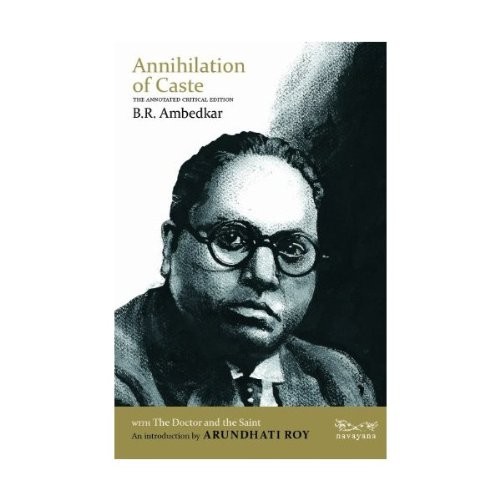
this one’s not a novel and I want to say that up front, because I almost skipped it thinking it wouldn’t fit next to everything else on my shelf. it’s a speech Ambedkar wrote in 1936 for a Hindu reformist organization, the Jat-Pat-Todak Mandal, who invited him to address their conference and then read an advance copy and canceled the whole thing rather than let him deliver it. so he published it himself instead. that alone tells you most of what you need to know about how uncompromising the actual text is.
the edition I read has the Arundhati Roy introduction, “The Doctor and the Saint,” and it’s worth knowing before you start that this is functionally two books stitched together, her long essay on Ambedkar versus Gandhi first, then Ambedkar’s actual undelivered speech. I went in for Ambedkar and came out with a much more complicated view of Gandhi than I walked in with, which I wasn’t expecting a book like this to do to me.
the argument itself is relentless in a way that surprised me. he doesn’t treat caste as a set of bad customs you could reform your way out of, he goes after the religious scripture underpinning the whole system directly, and argues that reform efforts that leave the scriptural authority intact are doomed from the start, because the system will just regenerate itself. there’s a line, something like the strong beating down the weak and wise men caring not, that’s stuck with me since I read it, it’s not flowery, it just states what’s happening plainly and lets the plainness do the damage.
what got me most is how current it reads. multiple reviewers pointed out the same thing I felt, that eighty-some years later almost nothing he describes has actually stopped happening. that’s a heavy thing for a text to still be true about.
five stars, though “stars” feels like the wrong unit for something this direct. dense in places if you don’t have background on the specific historical context, worth sitting with anyway.